
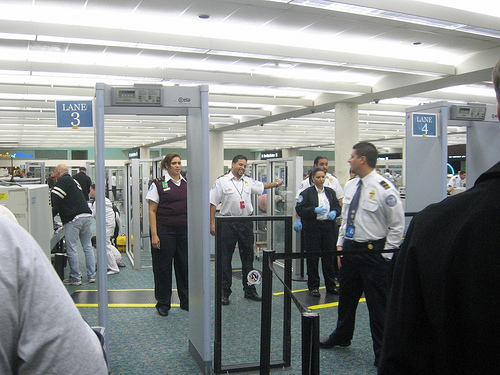
 Well, the talk went well yesterday, and pumping worked out fine – the conference organiser lent me her office, which was great. Airport security was not so great. My breastpump has an insulated compartment and a cooler pack that you freeze and then put in the insulated compartment so you can store the milk in there and it will stay cool. On my way to Oslo I took it through as hand luggage – without milk since I hadn’t pumped yet, and the security people (young women) said it was fine and waved me through. On my way home, the airport train was delayed and I didn’t have much time for my flight. I assumed since Bergen had said the cooler pack was OK, I’d be fine taking the pump, milk and cooler packs through security again. But no – this time the security guy (an old man – coincidence?) stopped me and said the milk was OK but not the cooler packs. I asked where I could find complete guidelines as I hadn’t been able to find anything about breastmilk when travelling without a baby or about cooler packs online. They were obviously not into people asking questions and said I’d have to ask the airline (?) or the general information desk for the airport. And if I was worried that the milk would go bad I could dump it.
I’ve never been angry in a security line before, but I sure was this time. I grabbed my stuff, marched out, and checked in my backpack with the milk and cooler packs in it – I took my laptop out and carried it. The breastpump would need a strap or something to be checked as the cover doesn’t fasten completely – and I’m concerned about whether it’s even sturdy enough to go through as checked luggage, it’s an expensive piece of machinery after all. I then raced to the gate, which was closing, and was the last person on board the plane.
Luckily my backpack got there despite being checked in so late – and the milk was fine.
The thing is, the Norwegian government wants me to breastfeed until my baby’s at least a year old. The Norwegian government ALSO wants me to get back to work and let the baby’s father have some parental leave. Starting in 2009, parental leave is 44 weeks (at 100% pay, or 56 weeks at 80% pay). Three weeks before the birth and 12 weeks after the birth are reserved for the mother. Ten weeks (usually taken at the end) are reserved for the father. And the remaining 19 (or 31 at 80% pay) weeks can be shared however the mother and father choose. This means that mothers on the 100% pay schedule will start to work again when their babies are just over 7 months old. That’s assuming the father takes the shortest possible leave. So you have to assume – or at least hope – that mothers will be breastfeeding and pumping at for at least five months, until their babies are a year old.
Pumping in the workplace is protected. More or less. But what about pumping while travelling for work? What about jobs where you must – or should – travel?
I can opt to travel less while I have small children. Many mothers and fathers do. But if I opt not to travel as much because pumping while travelling is too hard – partly due to security regulations – is that a gender discrimination issue? Or am I exaggerating, here?
Half of me wants to kick up a big fuss. At a minimum write a letter to the airport security people, to the Gender Equality and Anti-Discrimination Ombud, to Ammehjelpen (the Norwegian equivalent of the La Leche League) and to every parenting magazine in Norway. Increasing the firepower: call some journalists as well.
The other half of me just thinks ah well. Deal with it – travel less and when you do have to travel, dump the milk (pump MORE when you’re not travelling so you have enough to do this). Or use frozen peas as a cooler. Or check it all in. Unless you’re travelling for 12 hours. Current security rules are stupid and disadvantage many people, not just you.
But most people aren’t disadvantaged BECAUSE they’re breastfeeding, working mothers. Women that current government policies specifically want both in the workforce and breastfeeding.
What do you think I should do?
Update: I rang Flypassasjer.no which is owned by Luftfartstilsynet, the Civil Aviation Authority, which is in charge of airport security in Norway. Turns out bottled breastmilk with liquid-filled cooler pack is permitted! And that the problem is simply that some people “misinterpret the rules”. The friendly inspection boss I spoke with sent me an email confirming this and promised to add it to the F.A.Q. on the website “soon”.
(Photo by GodzillaRockit/Ionan Lumis – CC)
Links I discovered:
- There’s an Article about this very issue in yesterday’s New York Times!
- Here’s a discussion with contributions from, oh, 100 or so Wall Street Journal readers about how they dealt with pumping and business travel
- The Mama Bee links to the New York Times article and has five suggestions for how to make travel easier for pumping mums


Gro
This problems are interesting. As a breastfeeder it’s like you experience
the same problems that disabled people do.(Especially at airports). Maybe breastfeeding should be regarded as something that make you dysfunctional? Anyway, to me it just an example of the stupidity in this overprotected airport-safety routines.
And to try to argument against stupidity is often a waste of time.
Bill Cole
I share (and endorse) your outrage, though I think this may be less of a gender-equality issue than the fact that many airport security “rules” are vague, inconsistently enforced, and left to the arbitrary judgment of the security personnel, with no provision for its being challenged or questioned. There are plenty of stories about travelers of all stripes being harried in this way, but it certainly seems like their effects are particularly unfriendly toward families (the time that airline personnel attempted to *pat down* our 3- and 5-year old kids before letting them board the plane springs to mind). Sorry you had to put up with this nonsense.
David Brake
I confess to being surprised – I thought of Norway as more child-friendly and all-round helpful than that. Perhaps rather than confronting the airport authorities alone you could use a Norwegian SNS to form a pressure group and produce a petition?
jeremy
I’d say ‘minor fuss’, but not the one you are talking about. The one that you should make is in regards to your inability to easily find the policy statement or directions on the web stating, yes/no and this is how to comply. once that is taken care of, if the policy is not equal, then you should make the other fuss. There should be a clear document or letter that you could print out from the internets that you could have given the elderly gentleman(probably would have angered him, but such is life).
Margrethe
I definitely think you should do something, if you’re up for it. Not everyone is, but we (as in society) needs people who stand up 🙂
Jesper Juul
From a gender perspective, the parental leave regulations you mention also show that the Scandinavian countries are very ambivalent about the role of fathers: On one hand everybody will agree that fathers should play a bigger role in raising children. On the other hand, the combination of a guideline that children should be breastfed for a year, with the fact that part of the parental leave can be freely divided does mean heavy pressure to make sure it is the mother that stays with the child most of the time. At least Norway, unlike Denmark, has a large part of the parental leave assigned for the father…
pattie belle hastings
From yesterday’s New York Times:
Traveling Mothers Face Hurdles in Pumping Breast Milk
http://www.nytimes.com/2009/02/10/business/10breastfeed.html?nl=8hlth&emc=hltha1
Beverly
Jeremy has a good point about where to focus the fuss.
I am still trying to get over the very generous benefits ( 44 weeks at 100% pay!)
Gosh we have a long way to go in Canada!
Anne
You actually bought the pump? Never again will I listen to academics who complain about low pay 🙂
Airport security doesn’t mix with anything, so I share your outrage on a more general level rather than considering it a gender issue.
Clare Owens
That’s ridiculous, on a bunch of levels. If you have the time and the energy, I’d encourage you to take some kind of action, for sure.
The good thing is that you’ve blogged about it, and that in itself raises awareness of these issues 🙂
Simon
Major fuss! It’s about time the principalities and powers were challenged. They are supposed to work for us; we are not their playthings.
Jill Walker Rettberg
Wow, that NY Times article is spot on! And interesting that the TSA guy specifically says the cooling packs are permitted. Huh.
Anne, I didn’t actually buy the pump. I inherited my sister’s – so it’s well-used. And my god a good pump is TOTALLY WORTH EVERY PENNY – having experienced both horrible cheap pumps and this nine-year-old but perfectly wonderful Pump-In-Style I would forgo many other purchases in order to buy a good pump if I didn’t already have one.
M-H
If I were up to it, I would make as much fuss as I could. But be aware that some people may think you’re a freak (You do what? Ewwww! Breastmilk is regarded by some people as icky – it comes out of a body doesn’t it?) I think the advice to ask for clearer guidelines is good. Good luck and keep us posted.
kata
There’s another, older NYT article (http://tinyurl.com/czov8n) that describes how cynical and fairly pointless some of the newer airport security measures are, like the ones having to do with liquids.
Making a fuss and raising awareness of the absurdity of these security measures in any way is worthwhile, though of course only if you have the time and energy.
Jill Walker Rettberg
I think some people already do think I’m a freak, M-H – a male student who’s on Facebook didn’t comment directly on any of this, but posted a status msg that said “I’m not bringing a breastpump through airport security” which of course got various “huh?” comments from his friends, most of whom aren’t my friends. Ah well, someday maybe the mother of his possible future child will need to travel with a breastpump and he’ll get it 🙂
Koenraad
The Norwegian authorities have a document that lists relevant rules: http://www.luftfartstilsynet.no/multimedia/archive/00004/Oppdatert_-_Forbudte__4962a.pdf. This page mentions “Det kan gis unntak dersom vÊsken: skal benyttes i l¯pet av reisen og er n¯dvendig av medisinske Ârsaker eller for
sÊrlige nÊringsmessige behov, herunder barnemat”. It can certainly be argued that both breastmilk and cooling liquids for breast milk fall under this category.
Letizia Jaccheri
I was here trying to find a good reference for literature online and/or cooperative processes of writing. I started to read, I like the way you write. I have also had 2 children in Norway with all focus on breast feeding etc. I never managed this pumping stuff. It was 10 years ago and technology was not so mature and I am not as taugh, even if my Italian friends and family regards me as a kind of vicking heroin as I have taken the plane with 2 children under 3 years a couple of times. Ok, good to be hero for somebody. When you have time have a look here artentnu.com and give me a good reference for literature on line that teen-agers will find interesting. for the time being I refer to your http://jilltxt.net
all my best from sydney (sabbatica) Letizia
jill/txt
[…] Letizia Jaccheri: I was here trying to find a good reference for literature online and/or cooperative processes of writing. I started to… […]
jill/txt » woman writer can’t get jobs; creates exaggeratedly male persona and becomes big success
[…] I’m rather shocked at this story, I must admit. Obviously it’s hard to know whether you’d have more success as a man when you always present yourself as a woman. I’ve never experienced obvious discrimination, though I’ve certainly felt uncomfortable in meetings where everyone else is male. Oh, and fumed at the difficulties of breastfeeding while travelling and noted that applications aren’t evaluated equally and that I have (had? have…?) a tendency to act like a little girl, a typical mistake women make. […]
Ilona Alexander
I just had a very mean airport security guy at London Heathrow confiscating the ice pack from my breast milk storage bag. I argued for a while but had to give up the battle because I would miss the flight (and would get home too late to breastfeed my baby that night). The ice pack was a part of a very expensive Medela travel set and I can’t replace it easily. Like you, am wondering if making fuss (i.e. writing complaints) will get me anywhere – or at least help breastfeeding mothers in the future. Any thoughts? I have travelled with this ice pack on a number of occasions before with no problem – as you say part of the problem is the discretion given to individual security officer.