
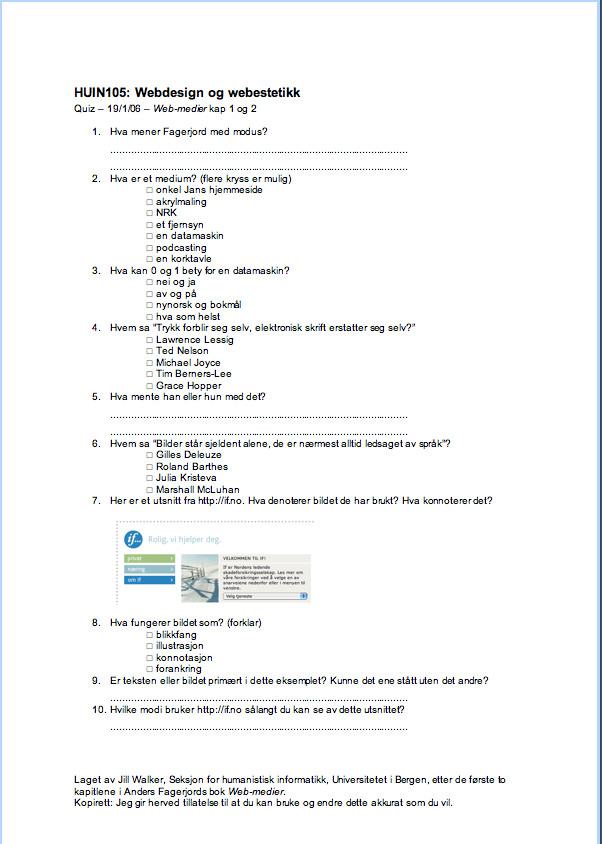
 This semester I’m using Anders Fagerjord’s brand new textbook Web-medier with our web design and web aesthetics students. For yesterday’s lecture I made a quiz for the students based on the first two chapters, which introduce a lot of concepts and ideas. It worked wonderfully – I gave students ten minutes to work through it individually, then about ten minutes to discuss it with their neighbours. After that we had nearly an hour of plenary discussion, which I really enjoyed. No grading or anything: the point was to get them to think through central concepts and apply them and discuss them. There are about fifty students in the class, so the standard strategy would be to lecture at them and leave discussion and student activity for the tutorials – but apart from all the excellent pedagogical reasons for engaging students in active learning rather than trying to pour one’s own knowledge into them as though they were empty vessels, I’ve discovered I really don’t like lecturing. When I think of my teaching as lecturing, I resent it and feel drained by it – all that preparation just to talk to a bunch of bored-looking students and get no feedback or input? Pah. Fortunately, active discussions with enthusiastic students leave me energised and flying back to my office remembering that I love my job.
The students had lots of good input in the discussion – out of nearly fifty students, I think at least 15-20 spoke, which is really good for such a large group. I asked them how they liked it at the end, of course, and they said it was great, and yeah, let’s do this again. As for me: I far prefer organising a class through a structured discussion than by me lecturing. Working with the questions individually and then in pairs got the students talking, and it was easy to spend nearly an hour simply going through the ten questions in the quiz and discussing them. And although it’s never easy to know what the students who don’t talk really think, they appeared to be alert and attentive, and I figure that at least they got to talk in the first part of class, with their neighbour. Oh, I snuck in fifteen minutes lecturing about Online Caroline too. I like lecturing for short bursts about things I’m really keen on 😉
Anyway. Here’s the quiz as an .rtf file – feel free to use it or adapt it if you’re teaching with Anders’s book. If I make more for the other chapters I’ll put them online too. Oh, there’s no answer sheet – I used it as a starting point for discussion, not for grading. (The file displays in my webbrowser with no images; if you right-click/apple-click the link to download it instead you’ll get a file you can edit in a word processor, with images.)


jill/txt » worksheet for Skartveit’s “Take the f train”
[…] Puzzling over how to explain students who’ve never tried it how to write a textual analysis I remembered how they loved the quizzes we did earlier this semester. So here’s a worksheet I made for Hanne-Lovise Skartveit’s Take the F train, which is one of the works they can choose to analyse. […]