

(UPDATE: Please read Harald Fougner from Gyldendal’s comment to this post, which shows that there is indeed more to this than I had imagined. Thanks Harald.)
One of the biggest Norwegian publishers, Gyldendal, is inviting new, unpublished authors to a writing competition in connection with their new app KORTLEST, which directly translated means “short reads” or “quickly read” and is supposed to suit our new habits of reading from phones and tablets while we’re waiting somewhere, or on public transport, or in between other activities.
This sounds fantastic. Until you read the rules, and realize that maybe Gyldendal hasn’t quite dived headfirst into the digital era yet. They want a story at least 50 pages long, or collections of stories or other texts of about that length. The prize-winning submission will be published as a book! Excerpts – only excerpts!? – will be published in the KORTLEST app. And submissions are only accepted on paper, not electronically.

I hope I’m not getting the full picture here. Because I’m going to be rather annoyed if I start reading a great story in KORTLEST and then have to go to a bricks-and-mortar bookshop to buy a lump of paper in order to read the rest of it.
I think Norwegian publishers – or maybe the Arts Council (Kulturrådet) – should invest in sites like Wattpad, which bills itself as the YouTube for literature. Wattpad is a Canadian site with over 8 million unique users a month and 3,2 million stories, and its app for phones is apparently the most downloaded reading app there is (above iBook and Kindle!?). Teens are among the most active users, and importantly, the default model is that you write your own stories as much as you read other peoples’. You upload a chapter at a time, share it on Facebook, receive (and write) comments and suggestions and add links to videos and music you think fits the mood of each chapter. Once a year you can submit a novel to the Watty Awards.
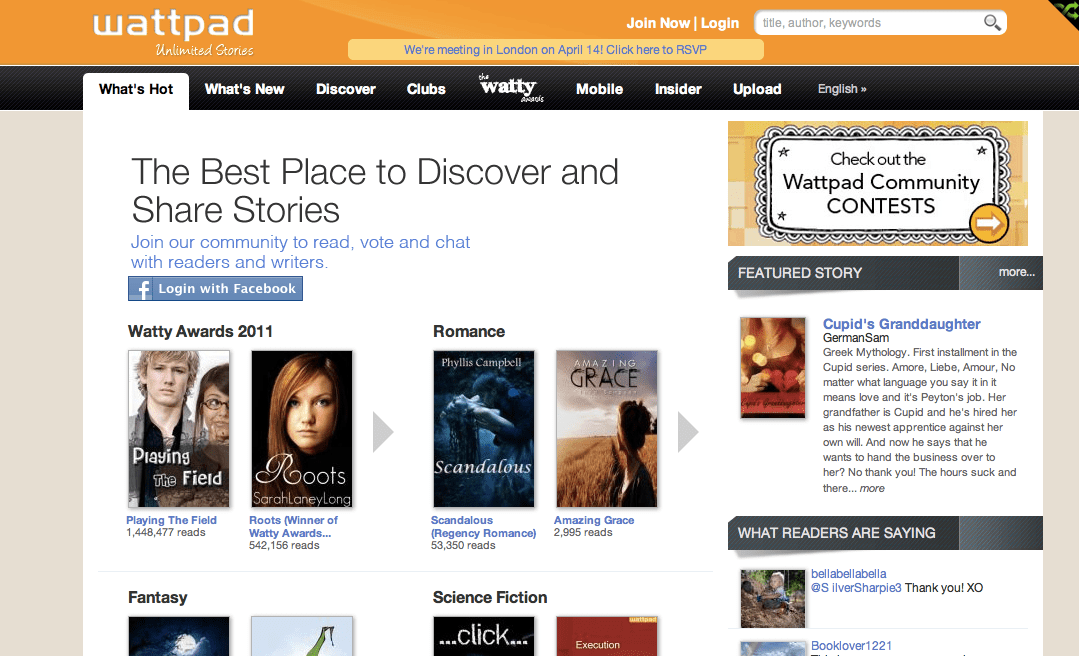
Wattpad is primarily English language, but Norwegian teens are on it too. Maybe we should fund a translation of the interface to Norwegian? Imagine if Norwegian teens were encouraged to write, to share their writing and to comment on each others’ stories – and Gyldendal or another publisher could host awards and publish the winners in other formats if they so desired.
Maybe that’s not a great business model for making a profit. But I don’t think traditional publishing is going to be a great business model either in the years to come.


Thomas
This is actually a pretty old concept here in Norway.
Skrivebua.no has been around for ages more than ten years and does exactly what you describe. Not so great at Facebook integration yet, but the social aspect is there and several of skrivebua contributors have since become published authors.
Mathias Klang
Another thing that confuses me with kortlest is that only the competition is bound to publish his/her novel. What happens to the rest? They will hardly fill the app with one story?
Harald Fougner
Dear Jill
The Kortlest application was launched in an attempt to experiment with new ways of reaching readers with different forms of short fiction, a genre of prose that never has had the amount of readers it deserves in Norway. We see new “mobile” reading situations as an opportunity to boost the reading of this kind of text. The launch has gone well and the application has been well received by readers and authors both.
As for the competition Kortlest, this was launched both to get more focus on short fiction and for recruitment purposes. We hope that both the winner and other applicants can be published with single short stories (because thats the point of the Kortlest apps, to focus on the short single stories, suited for “short” reading situations, not full books, also bear in mind: it says “without royalties”) in the Kortlest application. In addition the winner will be published in Vinduet in paper (and for the last 18 months also the iPad version). The winner also gets a book contract to be published by Gyldendal. And you dont have to go to a brick and mortar shop, for a while now all Gyldendals fiction has been simultanously published digitally and in paper so you can buy it as a ebook if you want to. It will probably also be sold as an ebook in the Kortlest app ( wihich is a side function in the app (the selling of full ebooks (from which the author will get full royalties))). You make it seem like we try to use digital bell-and-whistle initiaves to “drag” someone back into the world of paper, thats not how it works, we dont want to aquire single (paper) books, we want to help establish authorships, what format these are to be read in is up to the reader, we want to publish on all formats available for us.
I understand that it seems stupid not to accept entries electronically, but this is just based on experience. There has to be some kind of threshhold, otherwise we get scraps and bits, in many different version and different mails and if the author wants to publish his work enough to send in by snailmail, well chance is she put a bit more effort into the text.
I understand the need to poke fun of publishers “walking backwards into the future”, and often it might be correct, but I think the critique of Kortlest misses its mark.
(By the way I fully support the Wattpad-idea, as Thomas said above Skrivebua has been a lot like this, but I would like to see other sites like these, and it should probably not be an initiative from a single publisher.)
Harald Fougner,
Digital Publisher
Gyldendal Norsk Forlag
Paul Phillip
Thanks for this post about Wattpad. I’m actually working on a book about my fathers war stories and my own adventures as a young entrepreneur in graphic novel form. I’ve been meaning to publish it as a epub once it’s all done but if I can just work on a chapter a week that’s much more motivating. Again, thanks!