
I wrote an opinion piece for Aftenposten this week arguing that we need to be more tolerant of people who share personal crises – or for that matter, personal happiness – in social media. Yesterday, journalist Kjersti Nipen did a great follow-up interview with me, which resulted in a two-page spread in today’s Aftenposten, complete with a photo of me and the kids on our way down to Grønskjeret, because that’s what we were doing when the photographer caught up with us – it’s summertime, and the kids and I are off work and preschool for a few weeks.
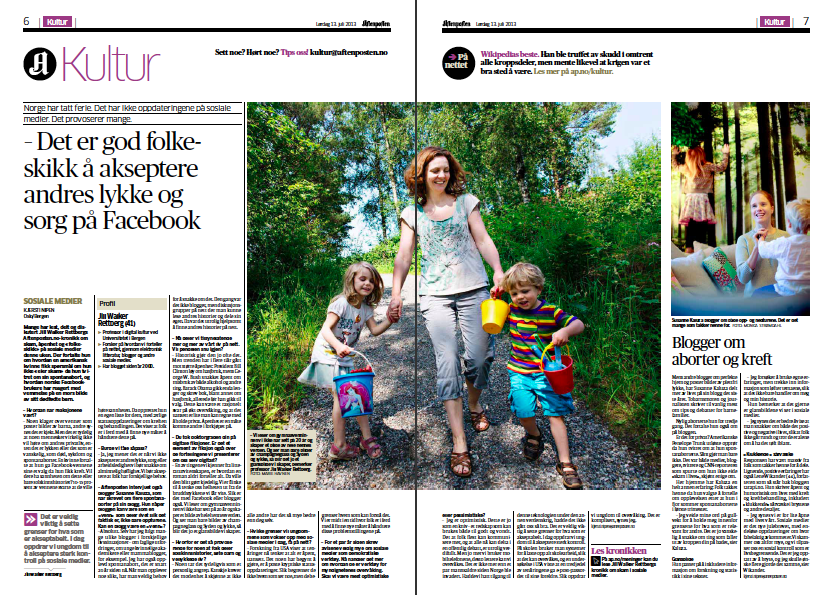
For non-Norwegian readers: the title of the interview is “Accepting other peoples’ happiness and grief on Facebook is just common decency”, which refers to the many, many complaints we keep reading, at least in Norway (how is this in other cultures?), from people who are deeply offended to read about their Facebook friends’ cancer treatment side-effects or see photos of their babies or read about their chronically ill children or see another photo of that beautiful beach in Spain.

In the interview, Kjersti and I talk a bit about the comments to my op-ed, which I found very interesting. There were (predictably enough) plenty of people complaining about what they saw as annoying and , but also some very interesting counter-strategies, like the woman going through cancer treatment who asked her Facebook friends whether they wanted to be on the “truth” or “sunshine” list. About 15% answered “truth”; nobody asked for sunshine. So now those 15% get to hear the gory truth, and the other 85% just get boring, bland posts that couldn’t possibly offend anybody.

I wonder whether the 85% now complain that Facebook is trivial and doesn’t provide true connections?

It seems some people will be offended by anything other than the most vapid, boring posts in social media. And often the same people will complain that Facebook is trivial and doesn’t provide true connections.

Unfortunately this piece is paper-only, though you may be able to read it on ATEKST if you have a university or library connection. The op-ed I wrote that this is a follow-up to is online-only, though, so you can read that: Skam og sosiale medier.


Discover more from Jill Walker Rettberg

Subscribe to get the latest posts sent to your email.

Leave A Comment

Recommended Posts

Academics in Norway: Sign this petition asking for research-based discussions of how to use AI in universities

I just signed a petition calling for Norwegian universities to use research expertise on AI when deciding how to implement it, rather than having decisions be made mostly administratively. ,  If you are a researcher in Norway, please read it and sign it if you agree – and share with anyone else who might be interested. The petition was written by three researchers at UiT: Maria Danielsen (a philosopher who completed her PhD in 2025 on AI and ethics, including discussions of art and working life), Knut Ørke (Norwegian as a second language), and Holger Pötzsch (a professor of media studies with many years of research on digital media, video games, disruption, and working life, among other topics).  This is not about preventing researchers from exploring AI methods in their research. It is about not uncritically accepting the hype that everyone must use AI everywhere without critical reflection. It is about not introducing Copilot as the default option in word processors, or training PhD candidates to believe they will fall behind if they do not use AI when writing articles, without proper academic discussion. Changes like these should be knowledge-based and discussed academically, not merely decided administratively, because they alter the epistemological foundations of research. Maria wrote to me a couple of months ago because she had read my opinion piece in Aftenposten in which I called for a strong brake on the use of language models in knowledge work. She was part of a committee tasked with developing UiT’s AI strategy and was concerned because there was so much hype and so few members of the committee with actual expertise in AI. I fully support the petition. There are probably some good uses for AI in research, but the uncritical, hype-driven insistence that we must simply adopt it everywhere is highly risky. There are many researchers in Norway with strong expertise in AI, language, ethics, working life, and culture. We must make use of this expertise. This is also partly about respect for research in the humanities, social sciences, psychology, and law. Introducing AI at universities and university colleges is not merely a technical issue, and perhaps not even primarily a technical one. It concerns much more: philosophy of science, methodological reflection, epistemology, writing, publishing, the working environment, and more. […]

screenshot of Grammarly - main text in the middle, names of experts on the left with reccomendations and on the right more info about the expert review feature
AI and algorithmic culture Teaching

Grammarly generated fake expert reviews “by” real scholars

Grammarly is a full on AI plagiarism machine now, generating text, citations (often irrelevant), “humanizing” the text to avoid AI checkers and so on. If you’re an author or scholar, they also have been impersonating and offering “feedback” in your name. Until yesterday, when they discontinued the Expert Review feature due to a class action lawsuit. Here are screenshots of how it worked.