
Did you look at Justin Hall’s blog lately? Justin’s been publishing his life online for eleven years, with an honesty (well, an apparent honesty, I don’t know him apart from his website so can’t verify anything, but it’s certainly truthful in the way that literature is truthful) and sustainability that’s awesome.
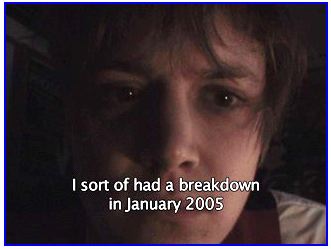
Screenshot of the first screen of Justin Hall's breakdown video, published January 2004Right now his usual site has been replaced by a ten minute video, where he cries into the camera asking how to combine his deep need to make media, write, publish, share with his need to have meaningful relationships and love. If the front page of his site is different when you go to look, here’s a direct link to the video.

Blogging, writing his life online, feeds some of the same needs as religion, Justin says:

What if a deeply connective personal activity you do that’s like religion that you practice with yourself, that’s a dialogue with the divine turns out to drive people away from you?

“There’s always someone there.” But it’s not working. “Because I can’t write about people because they don’t want to be there and I have nothing to write about (..) and I publish my life on the fucking internet and it doesn’t make people want to be with me, it makes people not trust me and I don’t know what the fuck to do about it.”

It is a form of art, this media-making so many of us have come to feel is part of life. I don’t want Justin the real person to be in pain, of course not, but a stop and a video like this is a strong narrative move and a cautionary note as well.

I’ve started reading Viviane Serfaty’s The Mirror and the Veil: An Overview of American Online Diaries and Blogs, which is a literary rather than an ethnographical or quantitative approach to diaries online. She notes the twofold nature of the screen, which is both a veil and a mirror:

The literal function of a screen is precisely to conceal and as a result of this perception, all kinds of highly controversial discourses are freely displayed on the Net. The screen seemingly offers a protection against the gaze of others, enabling each diary writer to disclose intimate thoughts and deeds, thus attempting to achieve transparency and braking the taboo of opacity regulating social relationships. (13)

Serfaty quotes Jean Starobinski, whom in 1971, writing of Jean-Jacques Rousseau, wrote what could as well be a description of bloggers and readers: “Making oneself invisible means one no longer is a mere transparency anyone can see thought, but that one has turned into a gaze no taboo can stop.” (Starobinski 1971: 302)
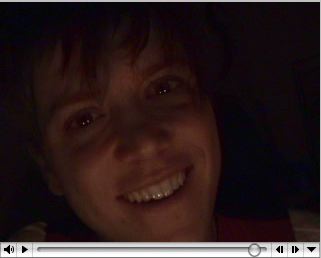
From the final sequence in Justin Hall's breakdown video, Jan 2005Look at Justin’s gaze, fixing the camera, fixing you, fixing himself. In the final moments, after the sobbing yet self-aware phonecall with a friend, right at the end of the video he’s wiped away the tears and whispers into the camera:

I’m alone because of what I did. And I’m going to be alone because of what I’m doing. Can you take that? How does that sound? [small smile] How does that sound? Hi? Hi, hi, hi…be alone. [smile] Do you like this? This is company. This is relating. This is relating. You’re crazy.

You’re crazy. Is he talking to himself, or to you? To the mirror, or through the veil?

“Without the prohibition of intimate disclosure, there would be no transgression. The prohibition therefore is constitutive of the meaning of self-revelation on the Internet.” (Serfaty 2004: 13-14)


Discover more from Jill Walker Rettberg

Subscribe to get the latest posts sent to your email.

2 thoughts on “transgression

  1. Francois Lachance

    Is not the line between fiction and actuality problematized for the viewer/reader whether it is the self (mirror) or the other (veil) that is addressed? Both fiction and the actual are part of reality. The is a temporal lag between the telling and the told that can give the teller space for recallibrating the telling, the told or even the teller. Indeed it is because acts of narration and narratives do not coincide that questions about the ontological status of the entites accessed through the narrative. The breakdown video is only one remarkable case of the mundane exercise of reading signs as evidence or symptoms. Leading or misleading signs.

    Mirrors can be broken; veils rent. Signs spin; narratives weave.

  2. shannon

    I’ve created an altered remix of Justin’s Dark Night. Some don’t
    like it and some do. You can find it here

Leave A Comment

Recommended Posts

Screenshot of a paragraph from a New York Times article published May 12, 2026. Text reads: "The price of tomatoes -tart bursts of flavor in salads and sandwiches — surged nearly 40 percent in April from a year ago on a combination of bad weather, high tariffs and climbing transportation costs."
AI STORIES

Genre glitches and unexpected promotional phrases as a sign of AI writing

A genre glitch is a characteristic of LLM-assisted writing where the text suddenly switches genre, typically inserting a short promotional phrase full of sensory details into an informational text. Genre glitches occur when a word in the generated text is heavily associated with a genre or context that is markedly […]

Top of a ransom note from Shinyhunters hacking group. Text reads: "SHINYHUNTERS rooting your systems since '19 ;) ShinyHunters has breached Instructure (again). Instead of contacting us to resolve it they ignored us and did some "security patches"."
Networked Politics University politics

UiB self-hosts the open source version of Canvas, so wasn’t affected by the breach

On May 1st Canvas announced a security breach, and then yesterday the system was hacked. The login page was replaced by a ransom note: if universities don’t pay up by 12 May, student data will be released. Here’s what the login page looked like yesterday: Way back in 2015, when […]

AI and algorithmic culture Networked Politics

AI-generated images, fascist aesthetics: Dieselbrølet and Heimatstrom

My German is pretty dodgy, so when I first saw Heimatstrom on Bluesky, shared by Roland Meyer, a professor of visual culture at Universität Zürich’s Digital Society Initiative, I misinterpreted it and thought it was a far-right campaign. But no, Heimatstrom is a group of left-wing environmentalists using fascist AI […]

Photo of a billboard ad at Oslo S train station showing a smiliing conductor and the text "Du må ikke sove. Joda, bare sov du."
AI STORIES

“Du må ikke sove”: a floating motif detached from its meaning (or: LLMs can write Norwegian but miss cultural references)

There’s a new ad for the train between Stavanger and Oslo in Norway that uses a line from Arnulf Øverland’s famous anti-fascist poem Du må ikke sove (“You must not sleep”). Du må ikke sove, you must not sleep, the ad says. And then it flips it, jovially, joda, bare […]

Academics in Norway: Sign this petition asking for research-based discussions of how to use AI in universities

I just signed a petition calling for Norwegian universities to use research expertise on AI when deciding how to implement it, rather than having decisions be made mostly administratively. ,  If you are a researcher in Norway, please read it and sign it if you agree – and share with anyone else who might be interested. The petition was written by three researchers at UiT: Maria Danielsen (a philosopher who completed her PhD in 2025 on AI and ethics, including discussions of art and working life), Knut Ørke (Norwegian as a second language), and Holger Pötzsch (a professor of media studies with many years of research on digital media, video games, disruption, and working life, among other topics).  This is not about preventing researchers from exploring AI methods in their research. It is about not uncritically accepting the hype that everyone must use AI everywhere without critical reflection. It is about not introducing Copilot as the default option in word processors, or training PhD candidates to believe they will fall behind if they do not use AI when writing articles, without proper academic discussion. Changes like these should be knowledge-based and discussed academically, not merely decided administratively, because they alter the epistemological foundations of research. Maria wrote to me a couple of months ago because she had read my opinion piece in Aftenposten in which I called for a strong brake on the use of language models in knowledge work. She was part of a committee tasked with developing UiT’s AI strategy and was concerned because there was so much hype and so few members of the committee with actual expertise in AI. I fully support the petition. There are probably some good uses for AI in research, but the uncritical, hype-driven insistence that we must simply adopt it everywhere is highly risky. There are many researchers in Norway with strong expertise in AI, language, ethics, working life, and culture. We must make use of this expertise. This is also partly about respect for research in the humanities, social sciences, psychology, and law. Introducing AI at universities and university colleges is not merely a technical issue, and perhaps not even primarily a technical one. It concerns much more: philosophy of science, methodological reflection, epistemology, writing, publishing, the working environment, and more. […]

screenshot of Grammarly - main text in the middle, names of experts on the left with reccomendations and on the right more info about the expert review feature
AI and algorithmic culture Teaching

Grammarly generated fake expert reviews “by” real scholars

Grammarly is a full on AI plagiarism machine now, generating text, citations (often irrelevant), “humanizing” the text to avoid AI checkers and so on. If you’re an author or scholar, they also have been impersonating and offering “feedback” in your name. Until yesterday, when they discontinued the Expert Review feature due to a class action lawsuit. Here are screenshots of how it worked.