
I don’t think I’ve ever been so tired in my life. I’m still tired, two days later, though I slept and slept last night. I’m exhausted. But hey! I did it!
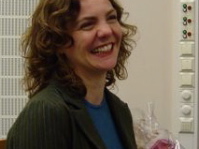
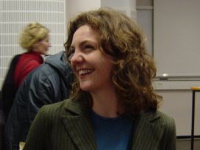
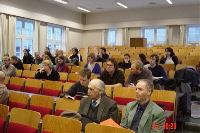
The defence was excellent. I was calm, and it wasn’t terrible once I was there. Everyone was there: my parents, my grandfather, colleagues from my department, from literature where I did my MA, from the media deparment where I’ve taught new media, from Intermedia, from other institutions in Bergen; Torill came from Volda and Lisbeth, Jesper and my wonderful supervisor Espen came all the way from Copenhagen. I think there were about forty people there all told. The photo of the audience below was taken by my mum, but you can’t see the front rows there. Mum took all these photos, actually: thanks, Mum!
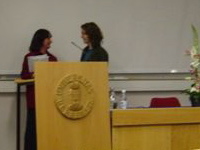
After I’d given a short, twenty minute presentation of my thesis, Marie-Laure Ryan, the first opponent, spent an hour discussing it with me. She’s an expert on the theories I’ve chosen as my main approaches to interactivity – possible worlds theory that discusses how readers (users) relate to the fictional worlds projected by representational works – so I’d been both dreading and looking forward to hearing her thoughts on how I’d used these theories. It was an interesting conversation, though I wish I could remember the details more. I remember talking about the differences between fictional and other worlds, and Marie-Laure had some insights I’ll certainly be using as I continue working on this. The photo below shows me thanking her after she’d finished grilling me! While the actual opposition was happening, I was over at the other side of the stage.
Even lunch was pleasant. It was a formal lunch of elegant open prawn sandwiches in a hotel, with the prodekanus, the committee members, my supervisor and me. It’s not the terrifying setting I’d imagined, it’s a pleasant way of simply chatting without pressure, and there is quite obviously a strong plan here of inculturating the candidate in an academic world. You’re being accepted into the tribe.
After lunch, it was the turn of the second opponent, Bj¯rn S¯renssen. He’s a media scholar, who started working on interactive video in the early 80s, and he offered a whole new approach to my topic: documentary theory. I’ve heard bits of this before, but since my background’s in literature, I’ve been more likely to compare Online Caroline or Uncle Buddy’s Phantom Funhouse to Dostojevski’s or Nabokov’s introducing a novel by saying that he found these papers in someone’s attic or something, rather than to Peter Jackon’s mockumentary about Colin McKenzie, the (fictional) forgotten New Zealand film maker. Bj¯rn showed an excerpt from the McKenzie film, and suggested several very interesting concepts from documentary – and mockumentary – theory that I could have used to think about the spams, hoaxes and fictions-pretending-to-be-real that I’ve written about. Bj¯rn also asked about ontology, which I use in Pavel’s sense, as being about worlds, and he suggested that Heidegger and phenomenology would have been useful. I read Heidegger before I started thinking about fictional worlds and crossing boundaries; perhaps if I’d read it again, now, I’d find it more immediately useful than I did then.
All in all I found the defence a wonderful, if somewhat anxious, learning experience. I have a lot of new leads for continuing my research, and I’ve had help in clarifying some concepts. It’s a wonderful privilege having two experts read your work that thoroughly.
Once finished, people started congratulating me and I just smiled and smiled and smiled. I think one of the most touching things was my students giving me flowers! I hadn’t expected that at all, and they were just so lovely! The students I mean, the flowers too, very lovely, but oh, what gorgeous students I have!
By this time, the chef (mum’s present to me, a totally brilliant present!) and his assistant had already filled the villa I’d rented for the party with delicious smells.
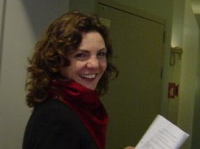
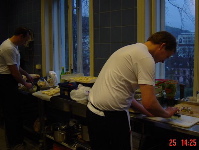
We stopped by for a quick checkup – mum and my girlfriends had set the tables the night before and everything looked wonderful, so after a couple of minutes, I went home and picked up my daughter from school and did the standard afternoon things: stirfried a meal, helped her with her homework, watched some TV – and both she and I got all totally dressed up. She in her princess dress (white lace, pink sash) and me in my fishtail skirt and mermaid corset. Taxi to the villa, last minute preparations with girlfriends and parents, and suddenly the house was full of people and champagne and presents and congratulations and it was amazing. My daughter left with her dad at nine, when food was served (just as she broke down in exhaustion; I lasted a little longer) and oh, the food was so good! Below is Thomas (and a bit of Jon) giving me a brilliant book of photographs. Next to that you can see Bj¯rn, my second opponent, with Gro, head of my party committee and a good friend ever since my comp. lit. days.
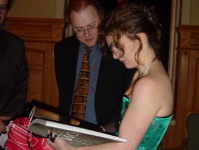
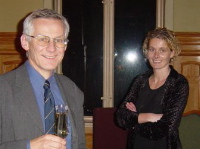
The dinner may be stressful to prepare on top of preparing the defence itself and the trial lecture, but in retrospect I realise that it, along with the lunch with the professors, is crucial: social networking is absolutely necessary in academia and it’s a skill that’s not often formally recognised as part of the job. Often seeds of important ideas and collaborations are sown in these less formal settings, and getting to know one’s colleagues socially allows much more fruitful collaboration later.
And of course it’s a wonderful high after the horror of the defence (or at least the horror of dreading it) to hear generous, appreciative speeches about yourself! The prodekanus‘s research field is religion, which turned out to be rather interesting since I spoke about avatars and fictional, sacred and actual worlds. She spoke about the defence as a rite of passage in her speech. Dag, the head of our department said lovely things too, one of the nicest being that they think I’m an excellent teacher! That made me happy. Espen said wonderful, generous things about me, and so did my mother, of course. Mum, who did her PhD at Cambridge in the late sixties, said that getting a PhD mightn’t make much difference in what I actually do, but that it’s more like getting an upgrade to business class. You’ll be treated with more respect, and you might get to slip more easily through the lines and red tape. That, along with my rather exuberant thank you speech, concluded the mandatory list of speeches, but Lisbeth slipped in a few words too, and oh, she was lovely. Everybody was lovely, really, I have wonderful friends and family and colleagues!
I’d forgotten to charge the batteries in my camera (ah well, I remembered a lot of other things) so I don’t have as many photos as I’d like. If you were there and took photos, do send me copies, please! Below is a cross section from before dinner was served: this is Jesper, Frank, Lisbeth, Carsten, Magne and Jon.
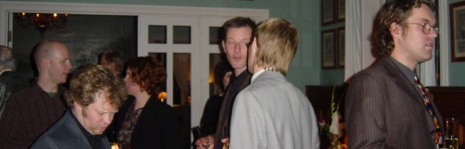
The Norwegian defence actually sets up a complete range of traditional, academic ways of exchanging knowledge. You’re given written response to your thesis, as reviewers do to papers you submit to (good) journals and conferences. You’re asked to prepare a lecture on a tight deadline. You go through an intensive question and answer session in the old tradition of academic debate. You eat lunch with the dean and professors in your field. You host a dinner for colleagues, family and friends, and again, you sit at the same table as your opponents, the dean, the head of your department, your supervisor and your parents. I continued my academic discussions with my opponents during dinner, but in a much more pleasant and cheerful manner.
The best, yes, the very best part of the day was after midnight, after the cakes and coffee and after quite a few people had left. I put on the music from Fame and we all, and I mean all, danced to it.
The last guests left at six. And yes, I did manage to get to Marie-Laure’s talk at noon, and I finished tidying and gave back the keys, and I picked up my daughter from school – and collapsed. We just watched videos all afternoon, eating leftovers from the party. I went to sleep right after she did.
Defences are usually on Fridays. That is a very sensible idea. You need a weekend or two after an ordeal like that.


Susana
Fame? Oh my oh my. How did you manage the stunts in the mermaid skirt and the corset? 😉 After this you will for sure live for ever.
Myrtle
You are such a wonderful writer that I just had to jump up and dance around with the Fame song playing in my head.
Thanks for opening this window into your life — you ARE a great teacher, even when the student may be unintended!
mcb
It almost makes doing a phd sound like fun…
congratulations, it sounds like it went really well.
hanna's mum
A stunning achievement —and a fantastic description! Very unlike anything we have here in the uk. Well done!
vika
Wow! I go abroad and slack on blogs, and here you are defended! Congrats, Jill, heartily. I look forward to meeting you *next week*, Doctor!
Cynthia Haynes
CONGRATULATIONS, JILL! I just read the story of your defense, and it sounds wonderful…I’m sure you had a blast, and it is so well-deserved! Anyway, congratulations again…well done! Hope to see you sometime during the holidays and at Jan’s defense.
Take care,
Cynthia
Jill
Thanks, everyone!!!
And I recommend the Fame music to everyone. Well, if you grew up watching the series, anyway 🙂
royby
Congratulations Jill. It sounds as though you had a real blast. Well done!
Cheers – Roy
chuck
Congratulations! I really enjoyed reading your narrative about your defense–sounds like a great experience.
Seb
Congrats, Jill!! I can relate to a lot of what you wrote, especially the part about smiling :)))
orchidophile
I just found your blog today. I too understand the relief of defending and getting the signatures. After the corrections and grad school approval, I slept and lounged for two days straight!
Congrats indeed!
*o
me
Jill is very cute.
GENDER & COMPUTING
Reports from Jill’s defense
Jill was turned into a doctor this week. Read full reports from Jill herself, from Torill and Lisbeth….
Mathemagenic
Learning from Jill’s PhD journey
Jill Walker has made a final step in her PhD journey .
i1277
TRANSFER COMMENCES IMMEDIATELY
Apropos Steve Espinola: For litt siden var jeg og s Jill Walker forsvare doktorgraden sin i fiksjon p internett, der