
Today’s Remix Culture class is about the Gutenberg Parenthesis:
a cultural realm where it is felt that cultural products (including stage plays and student essays) should be original, independent, autonomous compositions — the individual achievement and the individual property of those who create them.
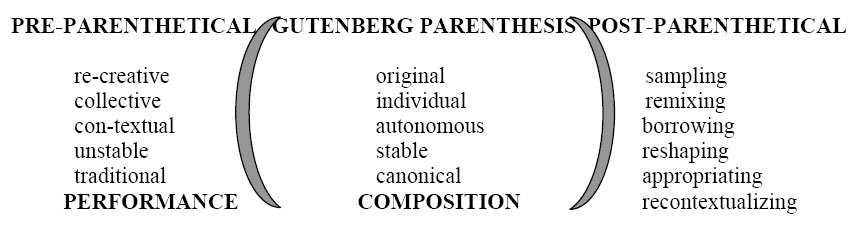
I first encountered the concept at Tom Pettitt’s plenary keynote at Media in Transition 5 conference in 2005. Here’s a PDF of his talk, or you can watch a video of his actual presentation. Pettitt starts speaking at 36:50 minutes into the video, and his talk lasts for about ten minutes. Here’s his diagram of characteristics of art and culture before, during and after the parenthesis:
And for a little more, you could see my presentation discussing the concept with librarians, which emphasises the meaning of silent reading and such – and the post includes some interesting objections from the librarians.
Having just read Mark Sample’s useful post about teaching electronic literature to students who experience it as a totally foreign culture, I’m thinking that his idea that we need to help guide students through the different stages from denial to integration might apply just as well to the Gutenberg Parenthesis. If there is a vast cultural difference between someone entrenched in the parenthesis and someone who has not yet entered it or has moved beyond it – well, perhaps we really need to think about how to communicate between these very different mindsets.
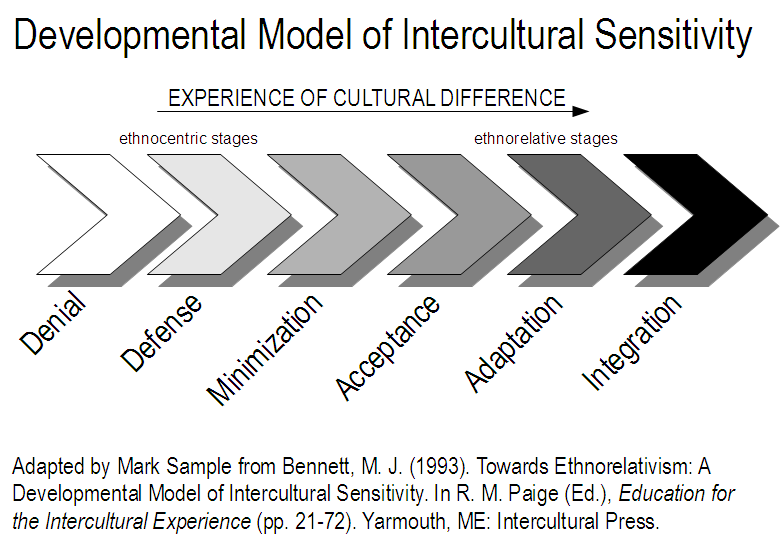
Mark Sample explains the stages thus:
In the early ethnocentric stages of Bennettís model, individuals begin by first denying that cultural difference exists in the first place, either because of their own isolation or because of willful ignorance. Greater exposure to cultural difference next prompts a defensive posture, an us-versus-them mentality in which existing cognitive categories are reinforced and any comment directed toward oneís own culture is perceived as an attack. The last ethnocentric stage is characterized by a minimization of difference. Individuals tell themselves that ìpeople are the same everywhere,î a superficially benign attitude that in fact masks uniqueness and still evaluates other cultures from a reference point within oneís own culture. The final three stages are marked by an understanding that behaviors, norms, beliefs and so on are all relative. The first ethnorelative stage is acceptance, genuinely acknowledging cultural difference and seeing that difference within its own cultural context. Next comes adaptation, when individuals change their own attitudes, behaviors, and even language to match their surroundings in an attempt to communicate and empathize. Finally, integration occurs when individuals move freely between cultures, practicing what Bennett calls ìconstructive marginality,î that is, seeing identity construction as an ongoing process that is always marginal to any specific social group.
Mark Sample goes on to argue that we need to construct assignments that help students move from denial to integration, or from ethnocentrism to ethnorelativism, for instance having students argue against the value of electronic literature and then for its value.
I wonder if this way of thinking could help us understand why issues of copyright, for instance, or filesharing or plagiarism, are so complicated and why people have such different ideas about them?
(Links for teaching:
- facsimile of early edition of Romeo and Juliet without author’s name but reference to the play having been plaid publiquely and with great applause – plays were slow to enter the parenthesis
- Shakespeare’s Sonnets, published with his name – poetry entered the parenthesis early. These facsimile’s may not be the exact ones that Pettitt cites but close enough for illustrative purposes (probably not for text scholars though!)
- Freestyle rap / the Dozens is an example of never-entered-the-parenthesis – this is an awful example since it’s Eminem but in a few minutes it’s the best I could do, sorry.
- Commedia dell’arte is an example of pre-parenthetical art (wikipedia)
Reading Reflections:


ania
Interesting intro/text on the experience of cultural differences and how the society adaps from jill/txt: http://jilltxt.net/?p=2427
Mark Sample
I hadn’t heard of the Gutenberg Parenthesis before, but I really like the concept. Pettitt’s chart is very evocative too. I wonder if our efforts to get students (or professors or librarians or etc) to recognize the potential of post-parenthetical culture are aided or hindered by their almost blasÈ acceptance of the more watered down elements of remix culture. That is, does their naive familiarity make it in fact more difficult to push through to the extreme versions of what is possible?
Going back to my argument about developing cultural sensitivity, I’d argue that regarding the Gutenberg Parenthesis, most students are in the “minimization” phase, in which they minimize the difference between what they know and what they presume to be the “other” way of doing things. Encouraging the transition between minimization and acceptance is probably the most difficult move on the chart.
Mark Sample
Some ideas between @jilltx and myself about teaching the Gutenberg Parenthesis using models of cultural difference: http://bit.ly/1a9ag0
Andrew Murphie
@jilltxt on cultural difference as applied to new media … applies to all manner .. eg unis, govts + open source http://bit.ly/2lY2HV
Tom Pettitt
Just to note that the “Gutenberg Parenthesis” research group also organized a session,”Gutenberg, Authority, and the Ordering of Experience”, at the next Media in Transition conference (MiT6) in 2009. The session features in the conference agenda, under Call Sessions 5, at http://web.mit.edu/comm-forum/mit6/subs/agenda.html, which also provides links to summaries of all three papers and the full texts of two of them. Mine reviews and elaborates the Gutenberg Parenthesis idea in the light of reactions and further thoughts in the intervening period, and explores whether, during the parenthetical period, perceptions of the world were rather, well, book-shaped.