
I’m in Copenhagen today, at the first meeting of a Nordic network on political communication online headed by Lisbeth Klastrup. The object today is to get some overview of activity in the different Nordic countries, and I’ve been tasked with presenting the Norwegian scene. Which, it turns out, is not that easy, especially since I guess I’ve actually been paying more attention to the US campaigns – oh dear, but, they’re just more entertaining, you know? And they’re using social media far more interestingly, at this point, with great hubs and commentators like TechPresident to keep us up to date about what’s going on. So anyway, I’m going to start by talking about the things that fascinate me about uses of social media in political communication: the user-generated things and the ways voters – and to some extent, campaigners – are inventing new ways of communicating and promoting their opinions. Here are a few examples I’ve enjoyed:
- Vote Different mashup by ParkRidge47 (YouTube, March 2007), a.k.a. Phil de Vellis, who called it a “citizen ad”. (Here’s an interview.)
- I got a Crush on Obama by Obama Girl/Barely Political (YouTube, June 2007)
- Black Eyed Peas frontman Will.i.am and other artists’ overlay/remix of an Obama speech (DipDive.com, YouTube, etc, January 2008).
These are all examples of remix culture, amateur production, user-generated culture, mashups. In the US, a 2005 survey by Pew showed that 59% of all teens uploaded their own content to the internet. 19% of all teens uploaded remixes of various kinds. There are to my knowledge no equivalent surveys of Nordic Also a product of American culture, where political advertising on television – the 30 second spot – is immensely important in campaigns. (There’s a wonderful recent documentary on this by CNN, “Campaign Killers”, that I can’t figure out how to buy or download – here are the teaching notes for it though.)
Other interesting developments in the US campaigns are the use of Facebook – for instance in the US Politics application that I think was set up by Facebook in connection with a television debate in January (at least that’s when I became aware of it.)
In Norway things are certainly not as sophisticated yet, but then, that’s not too surprising. The local elections in September 2007 used YouTube, but in a pretty elementary way – local elections obviously carry less critical mass than national elections because fewer voters are involved in each election. In France last year, it seemed use of the web was more sophisticated than in the US elections in 2004. This year’s US elections are using social technology far more. Presumably the national elections in Norway in September 2009 will be more interesting, seen from an online perspective.
What did happen in the 2007 local elections was that political parties started using YouTube. Arbeiderpartiet and many other parties published short, boring talking-head videos of every candidate. Most of these have about 36 views – and they don’t invite viral spreading. Apart from being extremely boring, they have comments and embedding disabled. I only found one campaigner who actually used YouTube’s features of answering other politicians’ videos in new videos (actually that was disabled so he fudged it), and he was ignored by the politician he answered.
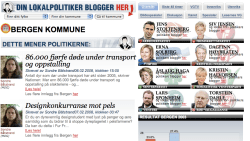 VG, one of the major tabloids, tried to forge their own online platform for politicians, Valg 2007. It’s basically a blogging system for politicians, presented as though all local Norwegian politicians are on it: “Your local politician blogs here!”. It encourages me to see what my local politicians are saying – but there’s only one blogger in Bergen, who’s from a party I’ve never even heard of. That’s a pretty small party, I’d say. Being utterly proprietory, this system doesn’t pull in other local politicians who have been blogging for years (e.g. Heikki HolmÂs. If I were a politician I’d be pretty suspicious of starting a blog on a tabloid newspaper’s website.
Arbeiderpartiet, which is the largest party in the coalition government, are currently working on updating their program, and their website invites everyone to “take part in the debate”. They’ve got their web 2.0 rhetoric right, but do they follow through?

Unfortunately, the answer is a clear no. The debate pages are slick and video-dense, with some cool Flash effects, and yes, they’re also posted to YouTube – with comments open, hooray! But the “take part” section is rather pathetic. Here are the options for participating:

Right. Send them an SMS (when I’m back in Norway I’ll try and see what/if they answer), send the talking head an email (no way to connect to other voters there), visit her blog – which is on VG Nett’s politician thing, in fact, or their Facebook group – which has had no activity since the election and where the few voter questions are not answered by the party – or go to YouTube, which is, perhaps, the best option. The interface for the videos is nice, though:

That’s about it for now – more later.


Martin G.
Oh, my. I would have loved to be there. I want to learn more about this. We expect prolific & extensive blogging reports! 😉
morley winograd
Good post. We just published a book in US summarizing the pre-2008 impact of social networks on American politics and describing how it will evolve. You might be interested. See website for more information.
Vox Publica » links for 2008-02-15
[…] jill/txt ¬ª political communication online: in norway? Forskere dr??fter politisk kommunikasjon p?• nettet. (tags: politikk medier internett) […]