
Cover image of Jill Walker Rettberg's book "Seeing Ourselves Through Technology"

Look! The book I was working on all spring has a cover, I’ve got till Tuesday to go through the proofs, and it will be published by Palgrave in less than a month! You can preorder it at Amazon.co.uk or Amazon.com right now, or wait a few weeks until the open access digital version is available.

I am really excited about this book. It’s about self-representations in digital media, which is a topic I’ve been thinking about and writing about for several years. Of course blogs are part of this, but in this book I wanted to understand digital self-representation in a much broader manner, and so I look at three modes of self-representation that each has a long history, but that are often intertwined in today’s digital culture:

  1. Written self-representations like blogs, tweets and a lot of what happens on platforms like Facebook and Tumblr.
  2. Visual self-representations like selfies, profile pictures on Facebook and Instagram feeds.
  3. Quantitative self-representations generated by activity trackers, calorie trackers, productivity trackers, to do lists and so on.

Each chapter has an abstract, as the chapters will be available for individual download as well as all together as a book. Here’s the proof of the abstract of the first chapter:
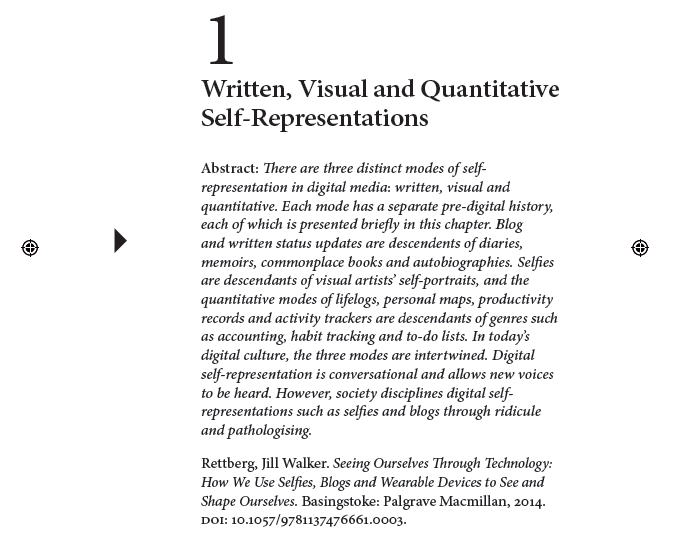
In working with this material I’ve become particularly fascinated with the ways in which machines are increasingly writing our diaries for us, whether through automated cameras like the Narrative Clip, through the wearable devices that allow the quantified self movement to generate visualizations and analyses that help them improve their lives, or by the automated data gathering performed by apps like Swarm, Moves or OptimizeMe, web services like Facebook or Google or our phone service providers and marketers.  The book thus moves from looking at digital self-representations in general to considering the relationships between people and machines, and lives and data in a much broader manner.

Here is the table of contents:

Rettberg-Seeing_Ourselves-TOCAnd it will be out in about a month!


Discover more from Jill Walker Rettberg

Subscribe to get the latest posts sent to your email.

3 thoughts on “My new book about selfies, blogs and wearables is almost here!

  1. Stine

    Så spændende! Den skal jeg helt sikkert købe. Vil den også findes i fysisk form eller kun digital?

  2. Jill

    Takk! Den kommer både fysisk og digitalt – den blir gratis å laste ned, siden det er CC-lisens på boken, og i tillegg selger Palgrave papir-utgaven til ca £20.

  3. Stine

    Det lyder godt – tak for svar, og tillykke med bogen.

Leave A Comment

Recommended Posts

Academics in Norway: Sign this petition asking for research-based discussions of how to use AI in universities

I just signed a petition calling for Norwegian universities to use research expertise on AI when deciding how to implement it, rather than having decisions be made mostly administratively. ,  If you are a researcher in Norway, please read it and sign it if you agree – and share with anyone else who might be interested. The petition was written by three researchers at UiT: Maria Danielsen (a philosopher who completed her PhD in 2025 on AI and ethics, including discussions of art and working life), Knut Ørke (Norwegian as a second language), and Holger Pötzsch (a professor of media studies with many years of research on digital media, video games, disruption, and working life, among other topics).  This is not about preventing researchers from exploring AI methods in their research. It is about not uncritically accepting the hype that everyone must use AI everywhere without critical reflection. It is about not introducing Copilot as the default option in word processors, or training PhD candidates to believe they will fall behind if they do not use AI when writing articles, without proper academic discussion. Changes like these should be knowledge-based and discussed academically, not merely decided administratively, because they alter the epistemological foundations of research. Maria wrote to me a couple of months ago because she had read my opinion piece in Aftenposten in which I called for a strong brake on the use of language models in knowledge work. She was part of a committee tasked with developing UiT’s AI strategy and was concerned because there was so much hype and so few members of the committee with actual expertise in AI. I fully support the petition. There are probably some good uses for AI in research, but the uncritical, hype-driven insistence that we must simply adopt it everywhere is highly risky. There are many researchers in Norway with strong expertise in AI, language, ethics, working life, and culture. We must make use of this expertise. This is also partly about respect for research in the humanities, social sciences, psychology, and law. Introducing AI at universities and university colleges is not merely a technical issue, and perhaps not even primarily a technical one. It concerns much more: philosophy of science, methodological reflection, epistemology, writing, publishing, the working environment, and more. […]

screenshot of Grammarly - main text in the middle, names of experts on the left with reccomendations and on the right more info about the expert review feature
AI and algorithmic culture Teaching

Grammarly generated fake expert reviews “by” real scholars

Grammarly is a full on AI plagiarism machine now, generating text, citations (often irrelevant), “humanizing” the text to avoid AI checkers and so on. If you’re an author or scholar, they also have been impersonating and offering “feedback” in your name. Until yesterday, when they discontinued the Expert Review feature due to a class action lawsuit. Here are screenshots of how it worked.