
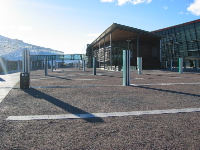
There’s a Jenny Holzer installation at the new Telenor building at Fornebu, a 30 kroner bus ride from Oslo, and on Saturday afternoon James and I went out to see it.
Running Letters consists of words that scroll from right to left across a band of red LEDs that stretches all the way along the top edge of one of the buildings, like a lace edging, or perhaps rather like the waistbands on some men’s underwear where the designers name is written repeatedly on the elastic. Words fly across this black and red band, more and more words, all the words Holzer’s ever published I suspect: her Truisms from the late seventies were there, her Inflammatory Essays, and just as we left we saw the beginning of Mother and Child. It’s done similarly to her installation at the Guggenheim a few years ago.

Many of the slogans are familiar to me. Maybe I’ve seen them before in books about Holzer, or perhaps they’ve been passed on from hand to hand for so long we’ve forgotten she coined them:
THE BEGINNING OF THE WAR WILL BE SECRET
Others surprise me by their playfulness:
SPIT ALL OVER SOMEONE WITH A MOUTHFUL OF MILK IF YOU WANT TO FIND OUT SOMETHING ABOUT HIS PERSONALITY FAST
Some are trite as the affirmations people buy in packs to stick on their bathroom mirrors, while others start with triteness but chill once read:
SAVOR KINDNESS BECAUSE CRUELTY IS ALWAYS POSSIBLE LATER
Later I discover these lines are not from Truisms, but from Survival, Holzer’s 1983 work. I suspect all her writings are displayed in this textband, one after the other, the complete works of Jenny Holzer, or rather, the complete words, displayed in one way that is not the only way in which they have been displayed.
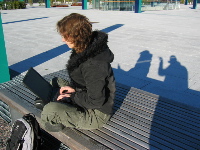 After walking through the space I sat on a bench and wrote while James photographed. I’m writing the introductory essay for a booklet Utsmykkingsfondet (the National Foundation for Art in Public Buildings) is publishing on electronic art in public spaces, and Holzer’s piece is one of the twenty that will be presented in the booklet. The other works don’t use words like hers does. Many are based on sound, some on video, some are generative. One of the works, Marius Watz’s Tegnemaskin 1-12, which I wrote about a couple of weeks ago, is in a digital electronic space, but the others are in physical public buildings and spaces: a train station in Oslo (Nydalen), a swimming pool in Trondheim, the new medical science building ten minutes walk from my house in Bergen. Many of the works respond to bypassers in some way, but very few respond in a way that passers by are likely to grasp and to some degree control. Holzer’s piece isn’t interactive at all, that’s not the point of it, its point, or one of its points, is that it’s constantly changing. The phrases and short essays are finite, but James and I were there for half an hour or maybe an hour without its repeating itself, and the words pass by so fast that you have to follow them carefully to read them before they’re gone. The band of moving red letters is partially obscured by a regular line of icicle-like taps of steel hanging down in front of them. If you click one of the photos above and look at the larger image, you’ll be able to see their shadows.
In an interview in Wired in 1994, Jenny Holzer said:
I’m always more at ease when something doesn’t actually exist. [Laughs] That’s my preference. I like things that are just electrical impulse and no more. Not necessarily neutral, but fleeting. (Wired interview, Feb 1994)
After ten minutes or so the sliding words stop. The LEDs go dark and James and I look at each other in surprise: surely they wouldn’t turn it off? They haven’t: a minute later, new words start to scroll across the long, long band. Later, reading one of James’s books about Holzer (he has several) I recognise the tiny almost-stories that come after the Truisms. They’re from Under a Rock, which was written and, uh, installed, I suppose might be the word, in 1986.
CRACK THE PELVIS SO SHE LIES RIGHT
THIS IS A MISTAKE
WHEN SHE DIES YOU CANNOT REPEAT THE ACT
THE BONES WILL NOT GROW TOGETHER AGAIN AND THE PERSONALITY WILL NOT COME BACK
SHE IS GOING TO SINK DEEP INTO THE MOSS TO GET WHITE AND LIGHTER
SHE IS UNRESPONSIVE TO BEGGING AND SELF-ABSORBED
Instead of full stops between sentences there are spaces wider than those between words yet narrower than those between the individual truisms.
Holzer did a web project in 1997, Please Change Beliefs, where she uses the text of Truisms (aphorisms originally pasted all over Manhattan in the late 70s and since displayd on billboards, tickers, printed on condoms and so on) and lets users suggest changes or additions, though these are collected in a “submissions” category and don’t change the authorative truisms on the front page. There’s also a section that displays some of her Inflammatory Essays in ugly underlined red against changing backgrounds.
DON’T TALK DOWN TO ME. DON’T BE POLITE TO ME. DON’T TRY TO MAKE ME FEEL NICE. DON’T RELAX. I’LL CUT THE SMILE OFF YOUR FACE. YOU THINK I DON’T KNOW WHAT’S GOING ON. YOU THINK I’M AFRAID TO REACT. THE JOKE’S ON YOU. I’M BIDING MY TIME, LOOKING FOR THE SPOT. YOU THINK NO ONE CAN REACH YOU, NO ONE CAN HAVE WHAT YOU HAVE. I’VE BEEN PLANNING WHILE YOU’RE PLAYING. I’VE BEEN SAVING WHILE YOU’RE SPENDING. THE GAME IS ALMOST OVER SO IT’S TIME YOU ACKNOWLEDGE ME. DO YOU WANT TO FALL NOT EVER KNOWING WHO TOOK YOU?
I wanted to see Douglas Gordon’s piece too, which is also at Telenor and also going to be presented in the booklet on electronic art in public spaces, but it was indoors and under lock and key. From what I’ve gleaned, Gordon’s piece is a manipulated version of the 1953 John Ford film The Searchers where the time of the movie is stretched so it takes five years to view it, the same amount of time as the fictional story lasts. Strangely fascinating idea, isn’t it?
Thanks to James for the photos in this post.


Elin
Hi Jill:-)
That was a great description! I’m curious about what you think about it though? What was the experience of being at the place like for you?
Jill
Oh! I forgot to say what I thought about it! That’s the sort of thing I berate students for: dare to have an opinion, don’t just describe!
OK, I’m going to add a paragraph, I’ll add it after I’ve been to the gym to practice being Lara Croft 😉
noah
Holzer had an LED installation at the Soho Guggenheim (RIP) which filled the space of the room with displays. I was standing there with some friends from the lab, and one of them started to say that ó despite the impressive setup ó he felt that maybe- and at that moment, the screens went dark, making the room dark, and before he finished his hesitantly-critical sentence they began to flash “DON’T TALK DOWN TO ME. DON’T BE POLITE TO ME.” He stopped talking. The lights kept flashing, accusing. We knew it wasn’t an interactive installation, but we walked out, quiet, looking at each other a bit nervously, smiling at our nervousness. Later one of us asked ó do you think it…? “Of course not.”
[image]
Jill
Oh, I love that, Noah. It’s hard not to be polite to art that talks to us, isn’t it?
I haven’t added my opinion to this post, there’s some opinion implicit in what I like, and there’s some more in today’s post where I note my disappointment in discovering that the only new words in Running Words are its title.
Carla Baquero
Hello
I¥m intersting to show the work of Jenny Holzer. “Just one thing about text it just isn’t art”, in Colomnbia BOgot·, in a exposition that is curated for a group of students.
I hope that i can be comunicated with the artist, or if the person that read this message can give to me some information i will be very happy.
Thanks
Carla
Howard Green
Saw this electronic display at Telenor in 2004 and was most impressed. Subsequently discovered work by Felix Gonzales Torres at Los Angeles MOCA which featured short historical events in series along top of wall surrounding exhibit hall such as:
mtv 1981, UN 1945, Watts 1965, NAFTA 1993, H-bomb 1952, “I have a Dream” 1963, “Just say no” 1984, and hundreds more. MOCA says will display again, but public needs to demand, so do so!
Howard Green
I was so impressed by the Telenor display that I found an executive from the firm who was willing to provide me the text as a DOC file. If this would be useful for research or historic purposes, I would be happy to share it with Professor Rettberg. It is approximately 12 pages long. The only “downside” is that it is totally in UPPERCASE, as one might expect from the source file for the electronic display. I do not know if the actual running text is randomized; this is grouped by subject matter.
Jill
Thank you, Howard! I would love to see the full text – I’ll email you. I’ve been back to Telenor a couple of times this year for meetings (almost a decade later, goodness) and it’s interesting how people just ignore this work. Even I just glance at it, feel thrilled that it’s there, and then go on with my business.